
Best starting point: SwimQwik for families considering private instruction in Issaquah; best for toddlers who need a parent nearby: a parent-supported format; best for children ready to share attention: a small group. Start with SwimQwik if small class sizes and flexible scheduling matter to your family, and confirm toddler eligibility and current scheduling terms before arranging a lesson.
TL;DR
For private swim lessons for toddlers Issaquah families should prioritize one-to-one instruction matched to their child's comfort.
SwimQwik serves families from its Issaquah facility; confirm toddler eligibility and current scheduling terms directly.
Parent-supported lessons suit children who need caregiver involvement; small groups suit children ready to share instruction.
Ask whether a free trial lesson is currently offered and how to arrange it.
Swimming lessons do not replace close adult supervision around water.
Why this matters
The best toddler swim lesson is not simply the smallest class. It is the format in which your child can participate, understand the instructor, and practice without being pushed beyond a manageable level of discomfort.
Private instruction gives one child the instructor's teaching attention. Parent-supported and small-group lessons organize that attention differently. Those differences matter more than a broad promise that a program works for every beginner.
For your 2026 search, separate three decisions: whether the school accepts your child's age, which teaching format fits, and whether the actual lesson schedule works for your household. A good answer to one does not settle the others.
What makes the best private toddler swim lessons?
Use these criteria before comparing lesson formats:
Individual attention: Confirm whether private means one child with one instructor, rather than a small shared class.
Toddler eligibility: Ask about the accepted age range and how placement reflects comfort and experience.
Parent involvement: Establish whether you enter the water, remain poolside, or follow another arrangement.
Teaching approach: Ask how the instructor handles distress, introduces unfamiliar skills, and adjusts an activity.
Scheduling fit: Check recurring times, rescheduling terms, and cancellations rather than assuming flexible means unrestricted.
Useful feedback: Look for clear explanations of what your child practiced and what needs more work.
Choose the format your child can participate in, not the label that sounds most advanced. A toddler who needs help separating from a parent has a different starting point from a child already comfortable following another adult's directions.
Toddler swim lesson formats at a glance
This comparison ranks teaching formats by the needs they address. Parent-supported and small-group formats are alternatives to evaluate with a provider, not a statement that every format is offered by SwimQwik.
1. Private instruction
Best for: Children who need individualized attention
Standout feature: One child receives the instructor's teaching attention
Key limitation: The setup must still suit the child's separation comfort
2. Parent-supported lessons
Best for: Children who need caregiver involvement
Standout feature: A familiar adult participates in the learning setting
Key limitation: Parent participation does not automatically mean private instruction
3. Small-group lessons
Best for: Children ready to learn alongside peers
Standout feature: Shared activities with other learners
Key limitation: Instructor attention is divided among children
Your first question should be about participation, not progression. Can your child engage with an instructor independently, with your support, or alongside other children?
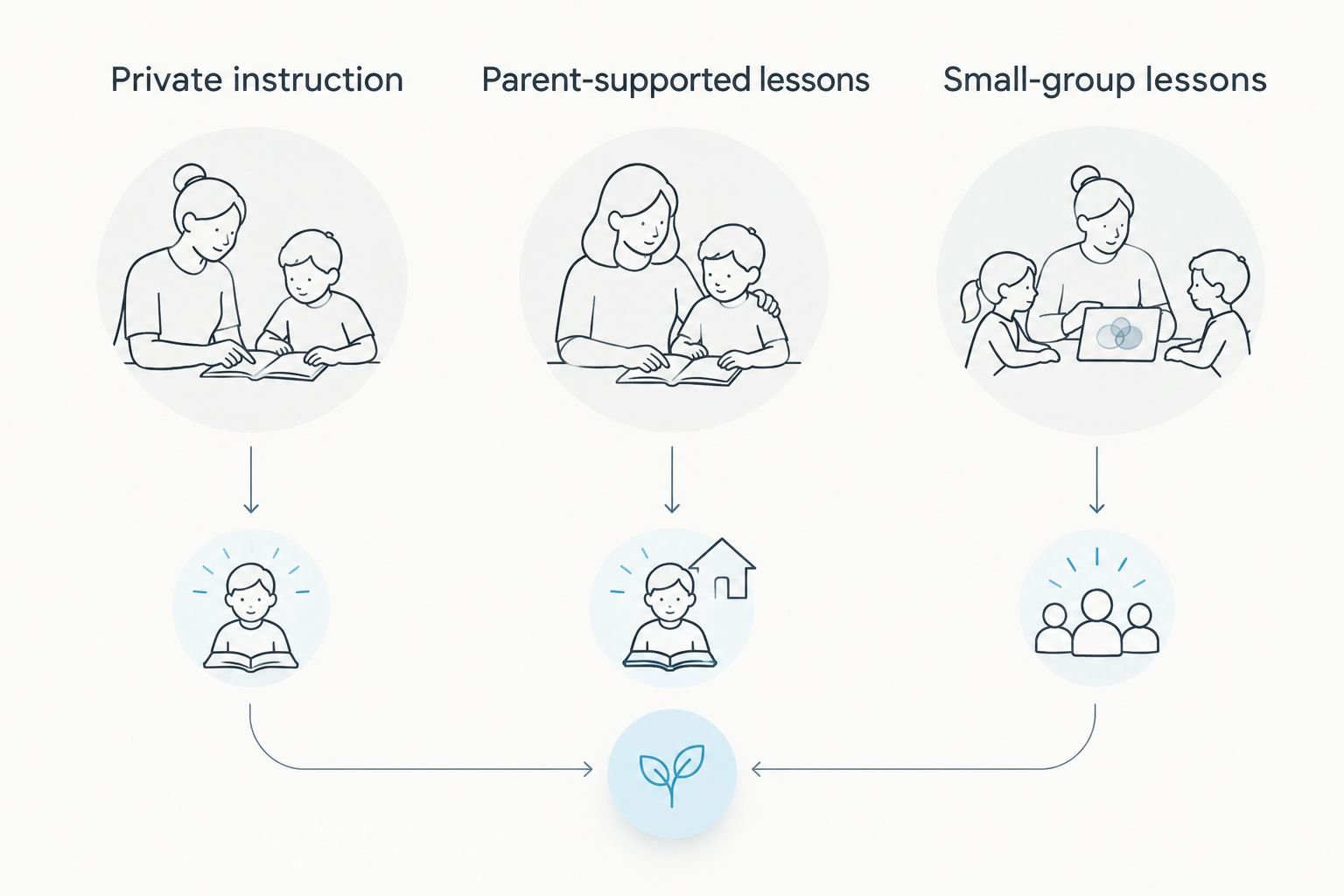
Choose the teaching arrangement around your child's current comfort and participation.
1. Private instruction: best for individualized toddler lessons
Private instruction gives one child and one instructor a focused teaching arrangement. In a 1:1 lesson, the instructor can organize activities around that child's responses rather than coordinate several learners at once.
SwimQwik is a local option for families seeking private swim lessons at an Issaquah facility. Confirm that the current program accepts your toddler's age and ask how the school handles the first lesson, parent involvement, and placement.
Private instruction pros
Your child receives the instructor's teaching attention rather than sharing it with classmates.
The instructor can adjust an activity without coordinating a whole group's needs.
You can discuss your child's specific concerns and goals before instruction begins.
Feedback can focus on your child's participation and next steps.
Private instruction cons
One-to-one teaching does not remove separation anxiety or guarantee immediate participation.
Private lessons do not provide the same peer setting as a group.
The right format still requires a workable instructor and schedule match.
Best for: A toddler who benefits from individual pacing, needs help with a specific sticking point, or finds shared instruction distracting.
Before choosing private lessons in 2026, ask what happens if your toddler will not enter the water or becomes upset during an activity. A useful answer explains the instructor's response rather than promises a fast result.
Verdict: Choose private instruction when individual attention is your priority, after confirming toddler eligibility and parent-participation arrangements.
2. Parent-supported lessons: best for caregiver involvement
A parent-supported format includes a caregiver in the learning arrangement. The exact role varies by program, so ask whether you enter the water, assist with activities, or stay nearby.
This is not automatically a private lesson. A parent-supported session can involve an individual child or several families; confirm the structure before treating it as an alternative to one-to-one instruction.
Parent-supported lesson pros
A familiar caregiver remains involved in the learning setting.
You can see how the instructor introduces activities and responds to your child.
The format gives you a direct role rather than requiring immediate separation.
Parent-supported lesson cons
Your participation becomes part of the scheduling and preparation requirements.
A shared parent-child class still divides the instructor's attention.
Caregiver involvement alone does not establish a suitable teaching approach.
Best for: A toddler whose main obstacle is participating without a parent or familiar caregiver.
Ask how the program decides when to change the caregiver's role. The answer should relate to your child's participation, not an assumption that every child follows the same sequence.
Verdict: Choose a parent-supported format when caregiver involvement is the immediate need; verify whether instruction is private or shared.
3. Small-group lessons: best for children ready to share instruction
Small-group lessons bring several learners into a shared teaching session. Children practice within a group structure rather than receiving the instructor's attention throughout the lesson.
A group is a different teaching arrangement, not simply a private lesson with company. Compare the actual class size, learner placement, and parent arrangements before deciding that it fits your toddler.
Small-group lesson pros
Your child participates alongside other learners.
Shared activities provide a setting for following group directions.
You can assess whether your child enjoys learning with peers.
Small-group lesson cons
Instructor attention is shared rather than dedicated to your child.
Activities must account for more than one learner's needs.
A child who needs repeated individual reassurance can find the format difficult.
Best for: A toddler who already participates comfortably around other children and can engage while the instructor helps someone else.
Do not choose a group solely because your child enjoys social play. Enjoying other children and being ready to learn in a shared water lesson are separate considerations.
Verdict: Choose a small group when your toddler is ready to share instruction; prioritize private teaching when individual support remains the main need.
How these formats rank
Private instruction ranks first for individualized attention. Parent-supported lessons address caregiver involvement, while small-group lessons address shared learning with peers.
These are use-case recommendations, not a ranking of unverified local schools. The criteria are teaching attention, participation, parent involvement, and scheduling fit—not an unsupported claim that one format produces faster swimmers.
Questions to settle before arranging a trial
Use this 2026 inquiry checklist to turn a general interest in lessons into a clear decision. Keep the conversation focused on your child's starting point and the terms you would actually follow.
Age eligibility
Give your child's age and describe any previous lessons. Ask whether the program accepts that age and how it determines the appropriate starting arrangement.
Do not assume a school that teaches children accepts every toddler age. Confirm eligibility before planning around a particular format.
Parent role
Explain whether your child separates comfortably and how they respond to unfamiliar adults. Ask where you will be during instruction and what happens if your child needs reassurance.
This question matters even for private lessons. One-to-one describes the teaching ratio, not the parent's location.
Scheduling terms
Ask which lesson times you can request, whether sessions follow a recurring arrangement, and what rules apply to cancellations or rescheduling. Establish the commitment before choosing a time.
Flexible scheduling does not mean unrestricted scheduling. You need the current terms, not an assumption based on that phrase.
Trial arrangements
Ask whether a free trial lesson is currently offered, whether it applies to your toddler, and how to arrange it. Confirm what the trial includes before making plans to attend.
Treat the trial as a chance to assess fit. Watch how the instructor communicates, responds to hesitation, and explains the next step.
Ask about toddler lesson options
Confirm age eligibility, scheduling terms, and whether a free trial lesson is currently offered.
Which toddler swim lesson format should you choose?
Start with private instruction if your main goal is teaching shaped around your toddler. Choose a parent-supported arrangement when caregiver involvement comes first, and consider a small group when your child is ready to share attention.
For local families, SwimQwik's Issaquah facility is the location to assess. Bellevue, Kirkland, and the Lake Washington and Lake Sammamish areas are communities served, not additional facility locations.
Before committing to a recurring schedule in 2026, make sure the travel routine works alongside your child's meals, rest, and other commitments. A lesson arrangement needs to fit the family as well as the learner.
FAQ
What's the best private swim lesson format for a toddler in Issaquah?
One-to-one instruction is the best starting format when your priority is individualized teaching. Confirm the school's toddler age eligibility, parent-participation arrangements, and scheduling terms before choosing a lesson.
Does SwimQwik teach toddlers in Issaquah?
Confirm toddler age eligibility directly with SwimQwik before arranging a lesson. The school offers swim lessons for children and adults at its Issaquah facility, but you should establish the accepted age range for your child.
Are private swim lessons the same as small-group lessons?
No. Private instruction gives one child the instructor's teaching attention, while small-group lessons divide that attention among learners. Ask for the actual teaching ratio rather than relying on a class label.
Should I be in the water during my toddler's lesson?
Your role depends on the program's rules and the lesson arrangement. Ask whether you enter the water, remain poolside, or follow another setup, and explain your child's comfort with separation.
Can I arrange a free trial swim lesson?
Ask the school whether a free trial lesson is currently offered and whether your toddler qualifies. Confirm the arrangement process and what the trial includes before planning to attend.
What does flexible scheduling mean for toddler swim lessons?
Flexible scheduling needs to be defined by the school's current terms. Ask about lesson times, recurring commitments, cancellations, and rescheduling rather than assuming you can change sessions without restrictions.
Will private lessons make my toddler safe around water?
No lesson format makes a toddler water-safe or removes the need for close adult supervision. Treat swimming instruction as skill development, not permission to reduce supervision around pools, lakes, or other water.
One last thing
One-to-one instruction describes who receives the teaching attention; it does not describe how your child feels. A quiet toddler is not necessarily comfortable, and an enthusiastic toddler does not automatically need a more advanced lesson.
For your 2026 lesson decision, ask the instructor to explain one activity your child engaged with and one next step. That conversation gives you something more useful than a broad label such as beginner or confident: a clear picture of what the lesson is helping your child practice.