
Best overall: one-to-one private lessons. Best for children who enjoy learning alongside peers: a small group matched by ability. Best for children who need a familiar adult beside them: parent-assisted instruction. For swim classes for 4 year olds near Issaquah in 2026, start with SwimQwik and ask about private instruction, scheduling flexibility, and whether you can arrange a free trial lesson.
TL;DR
Prioritize private swim classes for 4 year olds when individual attention and a child-led pace matter most.
SwimQwik serves Issaquah families considering private swim lessons; ask about current scheduling and a free trial.
Small-group swimming lessons suit children comfortable taking turns and learning alongside peers.
Choose by your child's comfort and current skills, not age alone. Lessons never replace close supervision.
Why this matters
At 4 years old, a child can be eager to splash yet reluctant to put their face in the water. Another child the same age might enter willingly but struggle to wait for instructions. Those children need different teaching approaches, even when they fit the same age bracket.
The best lesson is the one that matches your child's comfort, gives useful instruction, and fits a schedule you can keep. Small class sizes and flexible scheduling belong at the top of your shortlist. For private lessons, small means one-to-one instruction—not a group with fewer children.
SwimQwik offers swimming lessons for children and adults at its Issaquah facility and serves families from Bellevue, Kirkland, and the Lake Washington and Lake Sammamish areas. Those nearby communities are areas served, not additional school locations. Base your decision on the actual trip to Issaquah, including the return journey with a tired child.
What makes the best swim classes for 4 year olds?
Use these criteria before comparing lesson formats for 2026:
Individual attention: Ask how the instructor divides attention and adjusts activities when a child needs extra help.
Readiness match: Look beyond age. Describe your child's experience with entering water, getting their face wet, listening, and separating from you.
Clear supervision: Establish who supervises before, during, and after the lesson, including handoffs at the pool.
Practical scheduling: Confirm the actual lesson time, recurrence, cancellation terms, and rescheduling process. Flexible does not mean unrestricted.
Useful feedback: Ask how the instructor explains progress and identifies the next skill to practice.
A manageable first visit: Find out what to bring, where parents wait, and how the instructor handles hesitation without forcing participation.
Treat these as decision criteria, not a checklist of promises. A lesson description tells you the format; a conversation and an observed first session help you judge whether that format fits your child.
Lesson formats at a glance
These rankings compare instruction formats, not competing local schools. Ask a provider which formats it currently offers for your child's age and readiness.
1. One-to-one private lessons
Best for: Children needing individual attention or a tailored pace
Standout feature: One instructor works with one learner
Key limitation: No same-lesson peer practice
2. Small-group lessons
Best for: Children comfortable taking turns alongside peers
Standout feature: Shared activities and opportunities to watch others
Key limitation: Instructor attention is divided
3. Parent-assisted instruction
Best for: Children who need a familiar adult during the transition into lessons
Standout feature: A parent participates in the learning setting
Key limitation: Parent participation does not directly practice separation
A private lesson has 1 learner with 1 instructor. For group instruction, ask for the actual maximum enrollment rather than relying on the word small. For parent-assisted instruction, confirm whether the format accepts children aged 4 years and what the adult is expected to do.
1. Private lessons: best for individual attention
Private swimming lessons give one instructor responsibility for teaching one child. The instructor can focus the session on that learner rather than divide teaching time among a group.
For a preschooler, that matters when comfort and skills do not develop together. Your child might enjoy entering the pool but dislike water near their eyes, or willingly kick while needing help understanding how to stop and listen.
SwimQwik is the first option to consider for private swim lessons near Issaquah when your priority is one-to-one instruction. Ask how the instructor would approach your child's current starting point, rather than requesting a promised date for independent swimming.
Private lesson pros
The instructor can adjust an activity without needing the rest of a group to follow.
Your child's hesitation receives direct attention rather than being treated as a group interruption.
Feedback can focus on one learner's specific next step.
The format gives you a clear opportunity to discuss an individual concern before instruction begins.
Private lesson cons
Your child does not get same-lesson practice watching peers or taking turns with classmates.
Individual attention does not remove the need to find a suitable instructor match.
One-to-one teaching does not guarantee a particular learning speed or outcome.
Best for: A child who needs a personalized pace, finds group directions difficult, or has a specific skill to work on.
For your 2026 inquiry, describe what your child does now: willingly enters, holds the wall, avoids splashes, or needs you nearby. Concrete observations give the school more useful information than a broad label such as beginner.
Verdict: Hold paid booking until you confirm the private format, a workable schedule, and whether a free trial can be arranged.
2. Small-group lessons: best for learning alongside peers
Small-group swimming lessons place several children with an instructor. Children share teaching attention, participate in activities, and practice following directions around other learners.
This format suits a child who enjoys company and can tolerate waiting while another child receives help. Watching a peer try an activity can offer a useful example, but the group still needs an appropriate ability match.
Small-group lesson pros
Children can watch classmates demonstrate an activity before trying it themselves.
Taking turns becomes part of the lesson routine.
Shared activities give socially motivated children a reason to participate.
The setting provides practice listening when an instruction applies to the whole group.
Small-group lesson cons
The instructor divides attention among learners.
A mismatch in comfort or ability makes shared activities harder to pitch appropriately.
Waiting or noise can distract a child who already finds pool surroundings demanding.
Best for: A child who responds well to peers, follows shared instructions, and manages short periods of waiting.
Ask how children are grouped, what happens when one learner needs extended support, and how instructors keep the others supervised. A class labeled for preschoolers does not automatically match every preschooler's needs.
Do not choose a group simply because your child enjoys playdates. The relevant question is whether your child can participate comfortably in a pool lesson with shared attention. Swimming adds instructions, unfamiliar sensations, and supervision needs that ordinary social play does not necessarily involve.
Verdict: Hold enrollment until you confirm the group size, ability match, and supervision arrangements.
3. Parent-assisted instruction: best for a supported transition
Parent-assisted instruction includes a parent or caregiver in the learning setting. Depending on the program, the adult helps the child follow the instructor's activities and become familiar with the lesson routine.
This is a format to investigate when separation is the main obstacle. Confirm age eligibility and the adult's role before treating it as a suitable option for a 4-year-old.
Parent-assisted instruction pros
A familiar adult remains part of the child's introduction to lessons.
The parent hears instructions directly and sees how activities are introduced.
The instructor can demonstrate how the adult should support participation.
Parent-assisted instruction cons
The participating adult must be able to attend and follow the program's requirements.
Adult involvement does not itself build comfort with attending independently.
The format is not automatically suitable for every child of preschool age.
Best for: A child who needs a familiar adult involved before moving toward instructor-led participation.
Ask what happens as the child becomes more comfortable. A useful conversation covers both the immediate experience and the transition to a different format when appropriate; it should not force a deadline for separation.
If your child already follows an instructor comfortably without you, parent participation need not be the deciding feature. Choose the teaching arrangement that addresses the actual obstacle, not the arrangement that feels most reassuring to the adult.
Verdict: Hold enrollment until the provider confirms age eligibility, parent participation requirements, and an appropriate transition plan.
How these lesson formats are ranked
Private lessons rank first because they most directly meet the priorities here: individual attention and a pace shaped around one child. Small groups rank next for children ready to learn alongside peers. Parent-assisted instruction fills a different need: a supported transition when adult involvement matters.
These are suitability judgments, not measured comparisons of learning speed. The ranking changes when your child's needs change. A confident listener who enjoys group activities has a different starting point from a child who needs individual reassurance.
Before you arrange the first lesson
For a 2026 start, settle the practical questions before concentrating on what your child will learn first. Use this sequence when contacting the school.
Describe readiness. Explain previous lessons, comfort entering water, reactions to splashing, and any relevant support needs.
Confirm format. Ask whether instruction is private, who teaches, and how the approach fits your child's starting point.
Check scheduling. Confirm the current timetable and the terms for cancellations, missed lessons, instructor changes, and rescheduling.
Ask about trial. Ask whether a free trial lesson is currently offered and what steps are required to arrange it.
Plan arrival. Confirm what to bring, where to check in, where parents wait, and how supervision transfers to the instructor.
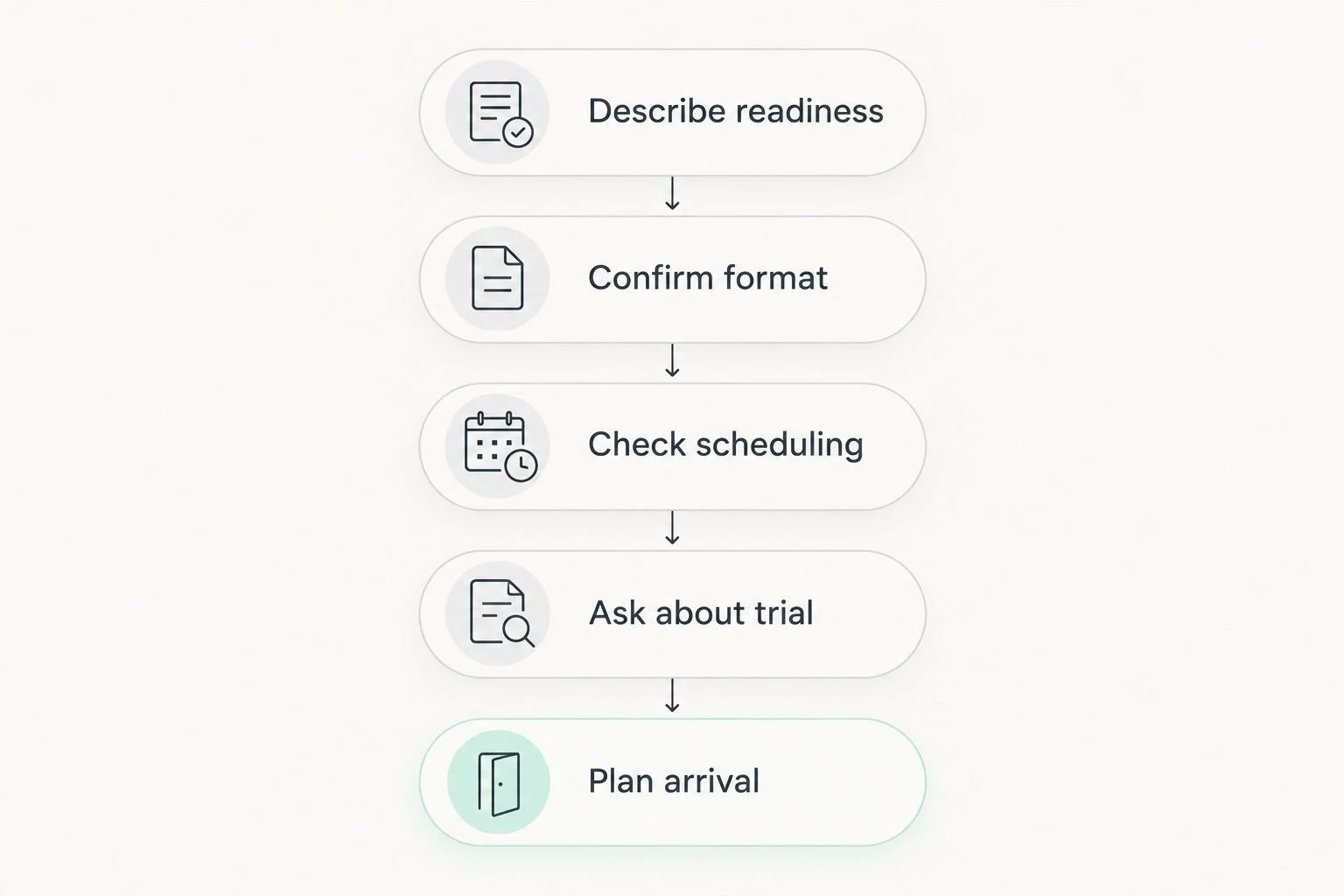
Confirm the format and scheduling terms before arranging the first visit.
Ask about the free trial before making a paid commitment, but do not assume that an offer, appointment, or walk-in arrangement applies. Get the current instructions directly from SwimQwik and follow the confirmed route.
Ask about a trial lesson
Confirm the current trial offer, private lesson format, and scheduling terms before arranging your visit.
Which swim classes should you choose?
Choose private instruction as your default when individual attention is the priority. Choose a small group when your child is comfortable learning alongside peers. Explore parent-assisted instruction when having a familiar adult involved addresses the main barrier to participation.
For families considering swim classes for 4 year olds in Issaquah in 2026, the next move is a specific inquiry, not an immediate booking. Ask how the lesson fits your child, whether the available schedule fits your household, and whether you can arrange a free trial.
After a first session, look beyond whether your child completed an activity. Did the instructor notice hesitation? Were directions understandable? Can you explain what the child will work on next? Those observations help you make a more useful decision than comparing broad promises.
FAQ
What's the best type of swim class for a 4-year-old?
Private lessons are the best starting option when a 4-year-old needs individual attention and a tailored pace. Small groups suit children comfortable sharing attention, while parent-assisted formats address a different need: having a familiar adult involved.
Are private swimming lessons better than group lessons?
Private lessons are better suited to individual attention; group lessons provide opportunities to learn alongside peers. Choose according to your child's comfort, listening skills, and ability to wait rather than assuming one format suits everyone.
Does SwimQwik serve families outside Issaquah?
SwimQwik serves families from Bellevue, Kirkland, and the Lake Washington and Lake Sammamish areas as well as Issaquah. Its facility is in Issaquah; the nearby areas served are not additional locations.
Can I arrange a free trial swimming lesson?
Ask the school to confirm whether a free trial lesson is currently offered and how to arrange it. Do not assume a walk-in visit or an unconfirmed appointment is available.
What does flexible scheduling mean for swimming lessons?
Flexible scheduling needs to be defined by the school's current lesson terms. Confirm appointment options, recurrence, cancellations, missed lessons, and rescheduling before committing; flexibility does not mean unlimited availability.
What should I tell the instructor before my child's first lesson?
Describe your child's previous swimming experience, comfort entering water, response to splashing, and ability to follow instructions. Mention relevant support needs and ask how the instructor will use that information.
Will swimming lessons make my child water-safe?
Swimming lessons do not make a child water-safe or replace close, attentive adult supervision. Continue appropriate supervision and follow pool rules regardless of lesson progress.
One last thing
Ask your child what felt comfortable, not just what they learned. A specific answer—such as liking the instructor's explanation or feeling unsure during a handoff—gives you something useful to discuss before the next visit.
Keep that distinction in your 2026 lesson plan: skill progress and comfort both deserve attention. Continue close supervision around water, and choose instruction that responds to the child in front of the instructor.